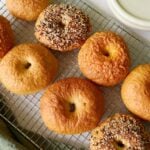
Sourdough Discard Bagels
These Sourdough Discard Bagels are quick, easy, and have a delicious chewy texture. They are made with instant yeast for quick rise times and can be on the breakfast table in less than 2 hours.
Servings: 14 bagels
Equipment
Ingredients
Bagel dough
- 150 grams sourdough discard ½ cup + 2 Tablespoons
- 400 grams water, room temperature 1 ¾ cups
- 15 grams sugar or honey 1 tablespoon
- 15 grams salt 2 ½ teaspoons
- 750 grams bread flour 5 ¼ cups
- 7 grams instant yeast 2 teaspoons
Baking soda bath
- 14 grams baking soda 1 Tablespoon
- Optional toppings
Instructions
- Mix & Knead: Add all the dough ingredients to the bowl of a stand mixer. Using your dough hook, knead the dough for about 20 minutes or until the dough can pass the windowpane test. If the dough gets too warm in the mixer (I find I can only do 20 mins in my Bosch mixer), I recommend kneading by hand at the end until the dough is soft, pliable, and can pass the windowpane test. You can also mix this dough in a bowl and then knead it by hand.150 grams sourdough discard, 400 grams water, room temperature, 15 grams sugar or honey, 15 grams salt, 750 grams bread flour, 7 grams instant yeast
- First rise: Transfer the bagel dough to a bowl or straight-edge container and cover. Let it rise in a warm spot until doubled in size. About 30-45 minutes at 80-90ºF, or longer at cooler temperatures.
- Divide dough: Once doubled, punch down the dough and divide the dough into 14 equal pieces, about 94 grams each. I like to use a bench scraper for this.
- Form into balls: Taking one section at a time, form the dough into a ball by pulling the sides to the middle of the dough and then flipping it over. With your hand in a cupping shape, rotate the dough ball a few times in a circle. Repeat with the remaining 13.
- Shape into bagels: Poke a hole in the middle of the dough and then, using both pointer fingers inserted on each side, rotate your fingers around each other, making a hole in the middle of the dough. Ideally, you want the size of the hole to be 1.5-2 inches.
- Prep paper: Cut 14 4×4-inch squares of parchment paper. Place a shaped bagel on each piece of parchment paper, and then place all 14 of them on two large baking sheets.Alternatively, you can place them on silicone mats, but when you pick them up to boil them, the shape of the bagel can change.
- Second rise: Cover with a slightly damp tea towel or lid and let the bagels rest for about 20-30 minutes until the bagels have puffed up slightly (you don't need to wait for them to double in size).
- Boil: While the bagels are rising, preheat your oven to 425°F. Bring a pot of water to a boil and add 1 tablespoon of baking soda. After they are finished rising, add a few bagels at a time to the boiling water, parchment paper side up, and boil them for about 45 seconds on each side. Once the bagels are in the water, you can easily remove the parchment paper from the dough. Use a slotted spoon or spider strainer to easily remove the bagels from the water and drain excess liquid. 14 grams baking soda
- Add toppings: Place the bagels on lined sheet pans, 7-8 to each pan. Add your toppings of choice to the tops (see notes on flavor options above and for tips on adding toppings to bagels).
- Bake: Bake for 18-20 mins or until lightly golden brown. Let the bagels cool on a wire rack and then enjoy them with butter or cream cheese.
The windowpane test is used to see how well the gluten has developed. When the dough is able to stretch thin enough that you can see light through, without it tearing, it has passed.
One easy way to create a warm proofing environment is to turn your oven on at the lowest temperature for 1–2 minutes, then turn it off. Before placing your dough inside, check the temperature with a thermometer to make sure it’s below 110ºF. Once it’s ready, place the dough in the oven, close the door, and let it rise.
Notes
- I highly recommend making individual parchment paper squares for the bagels to rise on. It makes it easier to put the bagels into the boiling water without messing up the shape.
- If you are kneading by hand, you can use warmer ingredients to speed up the proofing process. Use room temperature discard and water that is about 80°F. Warmer ingredients are not recommended when using a stand mixer because the mixer naturally warms the dough as it kneads. If the dough gets too warm, it can become sticky, weak, and harder to work with.
- For a warm spot for your bagels to rise, you can turn on the oven for 1-2 minutes at the lowest temperature and then turn it off so it doesn’t get too hot (you don’t want over 100°F). Then add the covered bagels to the oven and close the door. At 90°F, it will take about 30 minutes to an hour to rise.
- Knead the dough until it passes the windowpane test. This ensures proper gluten development in the dough.
- Add toppings, especially seasonings and seeds, when the bagels are damp to help them stick to the bagels.
- While the bagels rise for the second time, get the boiling water and baking soda ready before they are done proofing. If you wait to boil the water after they double in size, they could overproof.
- Dry seasoning - If you are adding seasoning such as everything bagel or cinnamon sugar, add the seasoning to a plate and then, after you boil the bagel and while they are still wet, dip them in the seasoning and then place on the baking tray.
- Cheeses - To add cheese, simply sprinkle it over the bagel after you have boiled it and add it to the baking tray. You can use whatever type of shredded cheese you'd like. And for a spicy kick, try adding pickled jalapenos too.
Nutrition
Serving: 1bagel | Calories: 209kcal | Carbohydrates: 42g | Protein: 7g | Fat: 1g | Saturated Fat: 0.1g | Polyunsaturated Fat: 0.4g | Monounsaturated Fat: 0.1g | Sodium: 690mg | Potassium: 58mg | Fiber: 1g | Sugar: 1g | Vitamin A: 1IU | Vitamin C: 0.001mg | Calcium: 8mg | Iron: 0.5mg
