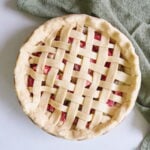
Sourdough Discard Pie Crust
This Sourdough Discard Pie Crust is flaky, buttery, and bakes up a beautiful golden brown. A family recipe turned sourdough, this pie dough is super easy to work with and makes the most delicious pie for all of your favorite fillings. This recipe makes 2 pie crusts, ideal for a 9" pie pan.
Servings: 2 crusts
Equipment
Ingredients
Sourdough Discard Pie Crust
- 280 grams all purpose flour 2 cups
- 5 grams salt 1 teaspoon
- 15 grams sugar 1 Tablespoon
- 150 grams butter, cold ⅔ cup
- 240 grams sourdough discard, cold 1 cup
- 45 grams water cold, 3 Tablespoons
Instructions
- Combine dry ingredients: Add flour, salt, and sugar to a food processor or mixing bowl.280 grams all purpose flour, 5 grams salt, 15 grams sugar
- Add butter: Dice up the cold butter and scatter it on top. Pulse for about 20 seconds or until the butter is in pea-size pieces. 150 grams butter, coldAlternatively, if you do not have a food processor, you can make the pie dough by hand. You can either use a cheese grater to grate frozen butter into the dry mixture or you can dice the cold butter into the mix and use a pastry cutter to incorporate the butter.
- Add discard: Add the sourdough discard and cold water and pulse until it begins to cling to itself. It will still be a little dry, but if you press it together, it should come together. If not, add one Tablespoon of ice-cold water at a time until it does. 240 grams sourdough discard, cold, 45 grams water If you are mixing by hand, add the discard and water and mix with a fork or Danish dough whisk until the dough begins to come together. It should hold together when pressed between your hands.
- Turn out the dough & chill: Turn the dough out onto a lightly floured surface and form it into a cohesive ball. Divide the dough in half and press into 2 discs about ½ inch thick. Wrap the dough in plastic wrap and put it in the fridge for at least 30 minutes, or up to 4 days.
- Roll out dough: On a lightly floured surface, roll out the dough with a rolling pin until it is 1–2 inches larger than your pie pan, about 12 inches wide and about ⅛-inch thick.
- Transfer the dough to the pie pan by gently rolling it around your rolling pin, then unrolling it over a 9-inch pie pan. You do not need to grease the pan. You can also fold the dough in half, then in half again, place it in the pie pan, and carefully unfold it. Gently press the dough into the bottom and sides of the pan.
- For a single-crust pie: Use a fork to poke holes across the bottom of the crust. Trim the edges and crimp or flute the edges. Bake according to the instructions for your specific pie filling.
- For a double-crust pie: Add your filling to the crust, then top with the second rolled-out crust or create a lattice design. Seal the two crusts together by crimping or fluting the edges. If using a full top crust, cut a few slits in the dough to vent.Whisk together 1 egg and 1 tablespoon of water, then brush the egg wash over the top crust. Bake according to the instructions for your specific pie filling.
If your pie dough has been in the fridge for a long period of time, you will likely need to let it sit out for 5-10 minutes to make it easier to roll.
Notes
- Don't overwork the dough. It will still be a little dry but when you press it together it should easily clump together.
- Use really cold butter and discard to ensure that the butter doesn't melt so that the butter doesn't leak and will create the flaky layer.
- You only need to blind bake if you are making something like a custard or cream pie that will bake for a short period of time or not at all, otherwise you can add your filling directly into the raw dough.
- If you find the dough isn't coming together, add a tablespoon of cold water at a time until it easily comes together when you press it with your hands.
- If the edges are getting too brown, you can cover with foil or a pie cover and continue baking until the middle of the pie is done.
Nutrition
Serving: 1pie crust | Calories: 198kcal | Carbohydrates: 23g | Protein: 3g | Fat: 10g | Saturated Fat: 6g | Polyunsaturated Fat: 0.5g | Monounsaturated Fat: 3g | Trans Fat: 0.4g | Cholesterol: 27mg | Sodium: 243mg | Potassium: 28mg | Fiber: 1g | Sugar: 1g | Vitamin A: 312IU | Calcium: 7mg | Iron: 1mg
