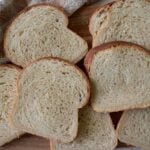
Sourdough Sandwich Bread
This delicious sourdough sandwich bread is so soft and fluffy! With easy to follow instructions, simple ingredients, and a forgiving timeline this bread is sure to become your new go-to.
Servings: 12 servings
Ingredients
- 150 grams sourdough starter, active and bubbly ⅔ cup (see note below for overnight)
- 100 grams milk ⅓ cup + 2 Tablespoons
- 160 grams water ⅔ cup
- 50 grams sugar or honey ¼ cup
- 57 grams unsalted butter, melted ¼ cup
- 10 grams salt 1½ teaspoon
- 100 grams whole wheat flour ¾ cup
- 400 grams bread flour 2¾ cups
Instructions
- Mix all ingredients together in a stand mixer or by hand. If you are doing the same-day schedule, use 150 grams of starter and warm liquids. If you are doing the overnight schedule, use 125 grams of starter and room-temperature liquid. 150 grams sourdough starter, active and bubbly , 100 grams milk, 160 grams water, 50 grams sugar or honey, 57 grams unsalted butter, melted, 10 grams salt, 100 grams whole wheat flour, 400 grams bread flour
- After mixing, knead the dough for 10–15 minutes—either in a stand mixer with a dough hook on low speed or by hand on a lightly floured surface. It will feel sticky at first, but as the gluten develops the dough will strengthen and become just tacky and easier to handle. Try not to add extra flour unless it remains very sticky even after several minutes of kneading.To determine when the dough is done kneading, perform a windowpane test. This should be done on relaxed dough so let your dough rest for a minute or two before completing the test. Gently pull a section of the dough thin enough to see light through. If it doesn't tear, then it is ready. If it tears, continue kneading for a few more minutes.
- Shape the dough into a ball and place it into a 2-quart straight-edge container or bowl. Cover the bowl and let it rise. Opt 1- Same Day Rise: Leave the dough at 80℉ to rise for 3-4 hours or until doubled in size. Opt 2- Overnight Rise: Leave the dough at 68-72℉ to rise for 8-12 hours or until doubled in size.
- Once the dough has doubled, punch it down and turn it out onto an unfloured surface. Grease an 8.5" x 4.5" (1-pound) loaf pan. Shape the dough into a rectangle, making the width about the same as the length of the pan. Starting from one short end, roll the dough up tightly, pulling it slightly toward you as you go. Place the log seam-side down into the prepared pan.
- Cover the pan and let the dough rise at 80℉ for about 2 hours or until the dough has risen about an inch above the loaf pan and fills the pan. The dough should feel light and if you poke the dough the indent should stay.
- Bake at 350℉ for 40-50 minutes (45 minutes is the sweet spot for me) until the internal temperature reaches 190℉ and the crust is browned.
- Remove the loaf from the loaf pan and place the bread on a cooling rack to cool before slicing.
Notes
- Store the bread in an airtight container or bag to prevent the loaf from drying out and store on the counter for up to 5 days.
- Save time by doubling the recipe and freezing an extra loaf for later. You can freeze it whole or pre-sliced. For a full loaf, place it in a freezer-safe bag and thaw overnight on the counter (leave it in the bag while it thaws). For slices, layer parchment or wax paper between each piece and store them in a freezer-safe bag. Then simply pull out slices as needed and toast or microwave to defrost quickly.
- Cold dough will rise much more slowly. For best results, place it in a warm spot. If it needs an extra boost, set the loaf in the oven with just the light on for 1–2 hours.
- If you notice air pockets forming at the top of your loaves, try poking a few holes in the dough with a fork before baking to help release the trapped air.
- The shaped dough can rest in the fridge for up to 12 hours before baking. After placing it in the loaf pan, let it rise for about an hour on the counter before placing it in the fridge. Keep in mind that the longer it ferments, the tangier the flavor will be.
- If preferred, you can swap the whole wheat flour for additional bread flour.
Nutrition
Serving: 1slice | Calories: 213kcal | Carbohydrates: 37g | Protein: 6g | Fat: 5g | Saturated Fat: 3g | Polyunsaturated Fat: 0.5g | Monounsaturated Fat: 1g | Trans Fat: 0.2g | Cholesterol: 11mg | Sodium: 328mg | Potassium: 77mg | Fiber: 2g | Sugar: 5g | Vitamin A: 134IU | Calcium: 20mg | Iron: 1mg
