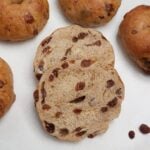
Cinnamon Raisin Sourdough Bagels
After countless rounds of testing, I finally landed on the perfect Cinnamon Raisin Sourdough Bagels with a chewy texture, plenty of raisins and cinnamon flavor, and just the right amount of sweetness.
Servings: 12 bagels
Equipment
Ingredients
Active Sourdough Starter (Levain)
- 75 grams sourdough starter ⅓ cup
- 75 grams flour ½ cup + ½ teaspoon
- 75 grams water 5 Tablespoons
Dough
- 350 grams room temperature water 1⅓ cups + 2 Tablespoons
- 225 grams active sourdough starter scant 1 cup
- 75 grams brown sugar ⅓ cup
- 15 grams salt 2½ teaspoons
- 1½ teaspoons ground cinnamon
- 715 grams bread flour 5¼ cups
- 240 grams raisins 1½ cups
Water Bath
- 2840 grams water 12 cups
- 14 grams baking soda 1 Tablespoon
Instructions
- Feed sourdough starter: About 4 hours before making the bagels build a levain or feed your sourdough starter at a 1:1:1 ratio (75 grams starter: 75 grams flour: 75 grams water). Cover and let it rest at 80°F (27°C) until bubbly and doubled in size.75 grams sourdough starter, 75 grams flour, 75 grams waterSkip this step if your starter is already activated and ready to bake with. If you don't have extra sourdough starter, use 80 grams of each so you have some leftover. Note: If you want to start the dough in the morning, feed your starter 10–12 hours in advance using a 1:5:5 ratio (25 g starter: 125 g flour: 125 g water). Leave it at 70–72°F (21-22°C) until bubbly and doubled.
- Mix & Knead: Add all the ingredients to the bowl of a stand mixer. Using your dough hook, knead the dough for about 15-20 minutes or until the dough can pass the windowpane test.You can also mix this dough in a bowl and then knead it by hand. If mixing by hand, I recommend using warm water. 350 grams room temperature water, 225 grams active sourdough starter, 75 grams brown sugar, 15 grams salt, 1½ teaspoons ground cinnamon, 715 grams bread flour, 240 grams raisins
- Bulk Fermentation (First Rise): Transfer the bagel dough to a bowl or straight-edge container and let it rise on the counter overnight, covered, until doubled in size. This will take about 8 hours, depending on the temperature of your house. At 72°F, my dough doubled in 8 hours.
- Divide & Form into balls: Once doubled in size, punch down the dough and divide it into 12 equal pieces, about 133 grams each. I like to use a bench scraper for this.Taking one section at a time, form the dough into a ball by pulling the sides to the middle of the dough and then flipping it over. With your hand in a cupping shape, rotate the dough ball a few times in a circle. Repeat with the remaining 11.
- Prep parchment paper squares: Cut twelve 4×4-inch squares of parchment paper. This step is optional, and you can place the bagels on a silicone baking mat instead. However, I find the individual parchment squares make it much easier to transfer the bagels into the boiling water without stretching or losing their shape.
- Shape into bagels: Poke a hole in the middle of the dough and then, using both pointer fingers inserted on each side, rotate your fingers around each other, making a hole in the middle of the dough. Ideally you want the size of the hole to be 1.5-2 inches.Place a shaped bagel on each piece of parchment paper, and then place all 12 of them on a large baking sheet and cover.
- Second rise: Let the bagels rise for another 1.5-2 hours to relax and get puffy. The bagels will not double in size.
- Preheat oven: After the bagels have had a chance to rise, preheat your oven to 425°F.
- Boil: Bring a large pot of water to a boil (about 12 cups of water) with 1 tablespoon of baking soda. 2840 grams water, 14 grams baking sodaAdd 3-4 bagels at a time to the boiling water, parchment paper side up, and boil them for about 1 minute on each side. Once the bagels are in the water, you can easily remove the parchment paper from the dough with tongs. Use a slotted spoon or spatula to remove the bagels from the water and drain excess liquid. Transfer to a cooling rack to remove excess water.
- Bake: Transfer the bagels to a lined baking sheet. Bake for 18- 20 minutes or until golden brown.Let the bagels cool on a wire rack and then enjoy them with butter or cream cheese.
The windowpane test is used to see how well the gluten has developed. When the dough is able to stretch thin enough that you can see light through, without it tearing, it has passed.
If you mix the dough in a mixer, your dough temperature will likely start higher, around 85-90°F, which will help boost fermentation. If you are mixing the dough by hand, your dough may take longer than 8 hours to rise because the starting temperature will be cooler. Using warmer water to mix the dough can help speed things up.
Notes
- I highly recommend making individual parchment paper squares for the bagels to rise on. It makes it easier to put the bagels into the boiling water without messing up the shape.
- If room temperature is 65°F or lower, use a temperature-regulated dough mat (use code country10 for 10% off) or proofing box to keep it warmer. Learn more about tips to keep your dough warm here.
- Knead the dough until it passes the windowpane test. This ensures proper gluten development in the dough.
- Use your sourdough starter at peak. Using a bubbly and active starter will set you up for success and help your dough to rise. Learn more about how to feed and care for your sourdough starter.
Nutrition
Serving: 1bagel | Calories: 316kcal | Carbohydrates: 69g | Protein: 8g | Fat: 1g | Saturated Fat: 0.2g | Polyunsaturated Fat: 0.5g | Monounsaturated Fat: 0.1g | Sodium: 824mg | Potassium: 234mg | Fiber: 3g | Sugar: 18g | Vitamin A: 2IU | Vitamin C: 1mg | Calcium: 30mg | Iron: 1mg
