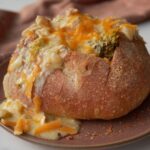
Sourdough Bread Bowls
These sourdough bread bowls are a mini version of my artisan sourdough bread recipe and is just the right size to fill with your favorite soup. Crusty on the outside, and soft on the inside, they are the perfect bread to accompany soup season!
Servings: 4 bread bowls
Equipment
Ingredients
- 150 grams sourdough starter ⅔ cup
- 500 grams bread flour 3½ cups
- 350 grams water 1½ cups
- 10 grams salt ½ Tablespoon
Instructions
- Mix the dough: With a danish dough whisk, hands, or large spoon mix together active starter, water, and salt in a 2 quart container with straight sides or a medium clear bowl. Add the flour and mix until the dough is shaggy and the flour is incorporated. Cover with a lid or dinner plate so the dough doesn't dry out and let sit for 30 minutes in a a warm spot. For a similar timeline as listed below keep the dough temperature at 75 degrees Fahrenheit. 150 grams sourdough starter, 350 grams water, 10 grams salt, 500 grams bread flour
- Stretch and folds: Perform a set of stretch and folds (pull dough out and then fold over itself, turn bowl and perform on other 3 sides) or coil folds every 30 minutes. Perform 3 sets. The goal is to get the dough to pass the windowpane test, described in more detail in the post. You can add your mix-ins in the first set of stretch and folds.
- First Rise: Let the dough rest on the counter in a warm spot to finish bulk fermentation. Bulk fermentation is done when the dough is jiggly, domed on top, bubbly on the sides, and risen 40-50%. If it does not show these signs, continue to let the dough rise. At a dough temperature of 75 degrees Fahrenheit my dough is ready in 4 hours from the time it is mixed.
- Pre-shape: Once the first proof is done separate the dough into 4 equal portions using a bench scraper. Pull the dough towards the middle into a ball and then flip it over. Cup your hands around the dough and rotate counter- clockwise while sliding the dough towards you. Let sit for 30 minutes on the counter. If your dough is extra sticky you can leave it uncovered to help dry it out slightly. Or, cover it with plastic wrap or a damp kitchen towel. This step can be skipped if needed but will help your mini loaves with their shape.
- Final Shape: To shape, take one portion of the dough and flip it over. Gently pull all the sides to the center of the dough and then turn it over. Cup your hands and begin rotating counter clockwise while sliding the dough towards you. Once you have a taut round ball place the dough upside down into a 5" banneton basket or cereal bowl lined with a tea towel and a dusting of rice flour or all-purpose flour. Repeat with the remaining three dough balls. Cover with a tea towel.
- Final Rise Option 1 Refrigerator Method (my preferred method)- Place the dough in the fridge overnight for 8-12 hours. Bake the dough directly from the fridge.
- Final Rise Option 2 Counter Method - Leave the dough on the counter for 1-3 hours (this will vary depending on temperature of kitchen and strength of starter). Once it passes the "poke" test, meaning when you poke the dough with a lightly floured finger the dough will slowly fill in. If the dough springs back immediately it needs more time and if it does not fill back in at all it is overproofed and needs baked immediately. Place the dough in the freezer while your oven preheats.
- Bake: When you are ready to bake place a baking steel or pizza stone in the oven at 400°F to preheat. Soak three tea towels in water and then roll them up and place them in a 8x8 or 9x9 pan. Add ½ cup water to the pan. When ready to bake, dump the bowls of dough onto parchment paper. Score an x on the top of each dough ball using a sharp knife or bread lame. Using a flat baking sheet, transfer the parchment paper with the loaves into the oven onto the hot baking steel. Place the pan of water and towels on the rack underneath. Bake at 400°F for 20 minutes. Then, remove the pan of water and follow with 15 more minutes at 450°F. You'll know the bread is cooked through if it sounds hallow when you knock on the bottom.
- Remove the bread from the oven and let them cool on a cooling rack.
- To serve the bread bowls, use a sharp knife to cut a circle in the top of each bread bowl. Hollow out the insides as much as desired and add soup and enjoy!
Notes
- For best results I recommend using the gram measurements instead of cups, as it will be much more accurate.
- Timing will depend on the temperature of your dough and the activity level of your starter. Watch your dough versus the clock.
- This recipe can easily be doubled or tripled.
Nutrition
Serving: 1bread bowl | Calories: 485kcal | Carbohydrates: 98g | Protein: 16g | Fat: 2g | Saturated Fat: 0.3g | Polyunsaturated Fat: 1g | Monounsaturated Fat: 0.2g | Sodium: 976mg | Potassium: 125mg | Fiber: 3g | Sugar: 0.4g | Vitamin A: 3IU | Calcium: 22mg | Iron: 1mg
