How to Feed & Maintain a Sourdough Starter (Step-by-Step)

Updated Feb 24, 2026
This post may contain affiliate links . Read my full Disclosure Policy.


If you’ve ever wondered exactly how to feed a sourdough starter, you’re not alone. Feeding your starter is one of the most important parts of baking with sourdough, but it doesn’t have to be complicated.
Whether you keep your starter on the counter and bake often or store it in the fridge between bakes, this step-by-step guide will show you exactly how to feed a sourdough starter so it stays bubbly, strong, and ready whenever you are. I’ll walk you through feeding ratios, schedules, visual cues to look for, and common mistakes to avoid so you can feel confident every time you refresh your starter.
Save & Summarize
Table of Contents
- Where do I get a sourdough starter?
- What do I feed my sourdough starter?
- What should I store my sourdough starter in?
- How do I feed my sourdough starter?
- How much do I feed my sourdough starter?
- Do I need to discard?
- How often do I feed my sourdough starter and where should I store it?
- When is my starter at peak?
- Troubleshooting
- FAQ
- Tips
Where do I get a sourdough starter?
If you’re brand new to sourdough and aren’t sure where to start check out my recipe for making a sourdough starter from scratch. Or you can buy a dehydrated starter or get a free dehydrated starter when you take my online class (if you live in the USA).
Once you get one you’ll be shocked how many recipes can be made with your sourdough starter from artisan sourdough breads, sourdough cinnamon rolls, sourdough granola bars, sourdough cheez-its, sourdough focaccias and more. The possibilities are endless.
What do I feed my sourdough starter?
Feeding your sourdough starter consists of giving it flour and water.
Flour
Sourdough starters can be made with a variety of flours from all-purpose, kamut, einkorn, whole wheat, rye, and more. Whichever type of flour your starter was created with, it’s best to continue feeding it the same type, as sudden changes can shock the starter. Even switching from non-organic to organic flour can cause a temporary slowdown.
If you ever want to transition to a different type of flour, do so gradually by mixing it in over several feedings.
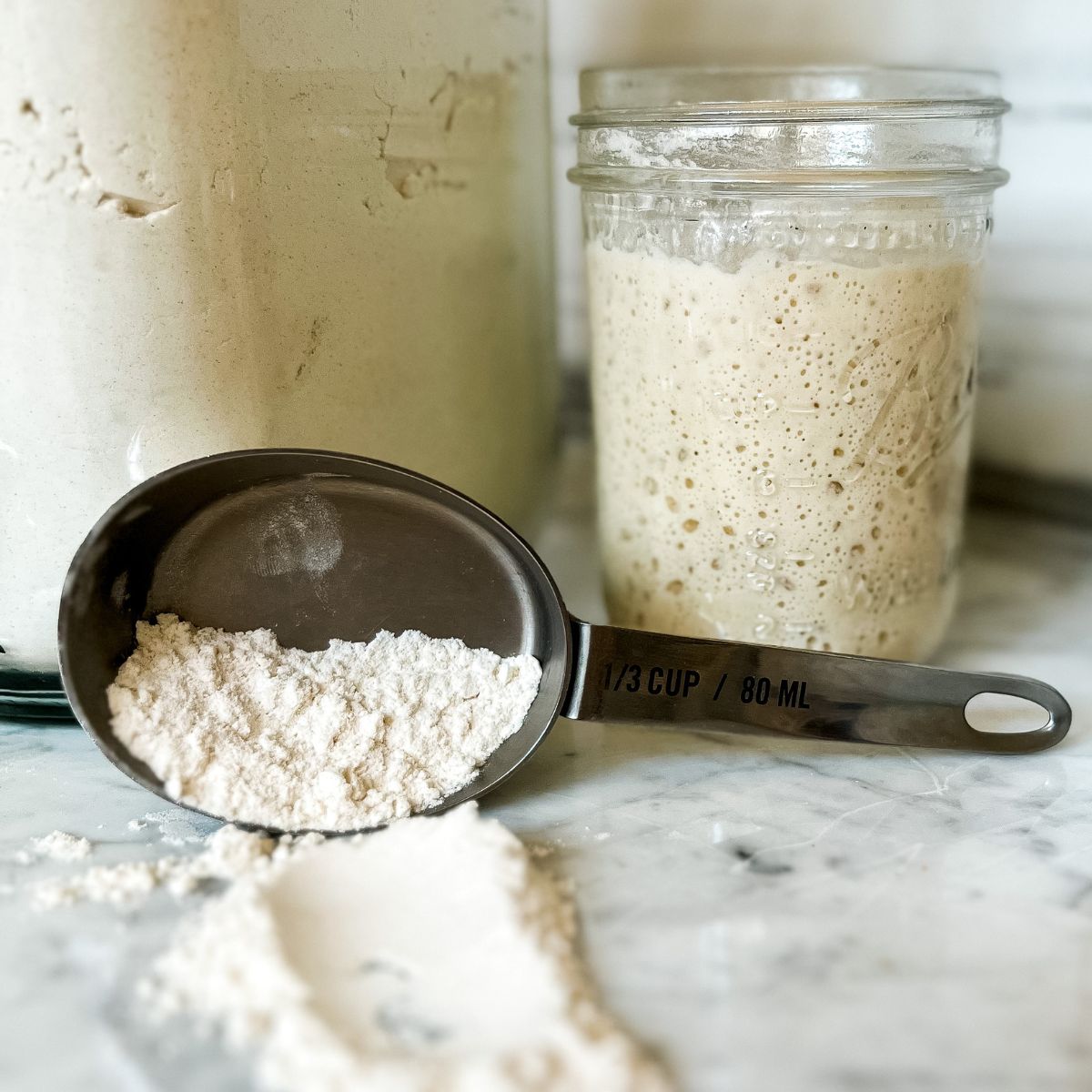
A common type of starter, and the one I use, is made with white flour. I typically use all-purpose flour since it’s more affordable, but bread flour works too.
While I personally prefer unbleached flour, it’s a misconception that bleached flour will kill your starter. If unbleached flour isn’t available or you simply prefer bleached, don’t worry, flour oxidation has no impact on your starter’s health.
Water
Any type of clean water should be just fine for your sourdough starter. I personally use tap water, but filtered water is also a great option.
There’s a common myth that tap water, especially chlorinated water, will kill your starter. In reality, while chlorine can slow fermentation, it won’t harm your starter in small doses. If you aren’t convinced, check out The Sourdough Journey’s video where 10% bleach was added to a starter without killing it!
Additionally, many of my online class students have had no issues using reverse osmosis or well water.
So don’t stress about using a specific type of water. But if your starter is struggling to rise, switching to filtered water might be worth a try.
What should I store my sourdough starter in?
I recommend using a straight edge, clear jar. I prefer to use a glass jar, this KneadAce jar is my favorite. But mason jars or Weck jars are good options as well. To cover the starter, I recommend using the jar lid or silicone lids that will keep the moisture in.
If you use the mason jar lid just be sure not to screw it on all the way, as you don’t want it airtight. Using a paper towel or tea towel will dry out the top of the starter so I don’t recommend either of those.

How do I feed my sourdough starter?
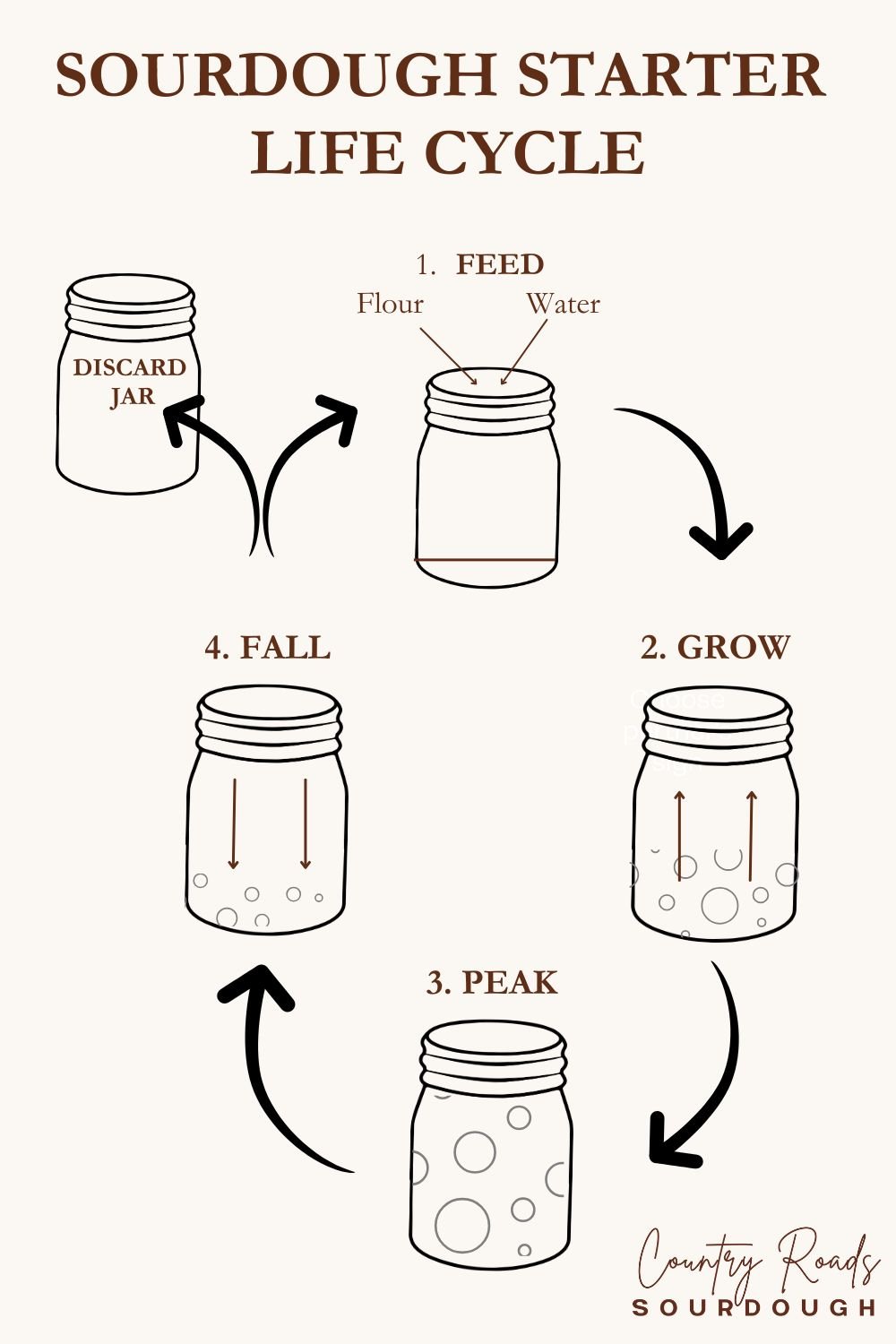
Before we dive in, let’s break down the sourdough starter cycle in the simplest terms. The good bacteria and wild yeast in your starter get hungry and need to be fed to continue to leaven your breads. A feeding consists of giving your starter flour and water.
The bacteria and wild yeast “eat” the food and “blow” bubbles (CO2) which causes the starter to grow. You don’t want to use it until it stops growing and begins to flatten out. This stage is referred to as “peak” and is the ideal time to make your sourdough bread.
After that, the bubbles begin to pop, and the starter begins to fall back down. The leftovers can now be considered sourdough discard. Some of the leftovers can be added to a discard jar that is left in the fridge for discard recipes and some can be fed to start the process again. If you don’t have much starter left over, you do not have to discard it.
There are two rules to remember when feeding your sourdough starter.
1. Feed your starter equal weight flour and water. This is referred to as 100% hydration, the most common type of starter used in sourdough recipes. If you’re measuring by volume (cups), remember that water weighs more than flour, so you’ll need to use half the amount of water compared to flour.
2. Feed your starter at least the amount in the jar or more. For example, if you have 50 grams of starter in the jar, feed it at least 50 grams of flour and 50 grams of water. However, I always recommend adding more flour and water than starter, we will talk about this more in the next section.
To feed your starter you will simply add the flour and water to the jar of starter and stir it up until the flour is fully incorporated. The texture will be a a thick batter consistency.
How much do I feed my sourdough starter?
As stated earlier you want to feed your starter at least what’s in the jar or more. Feeding your starter less than what’s in the jar is like snacking all day instead of eating a full meal, you’re left feeling unsatisfied.
Underfeeding your starter will weaken it over time and leave it constantly hungry. A hungry starter becomes overly acidic, sluggish, and less predictable in your dough.
Understanding Feeding Ratios
Feeding ratios are written as starter : flour : water.
If you feed your starter the same amount that’s in your jar, for example:
- 50 grams starter
- 50 grams flour
- 50 grams water
That is a 1:1:1 feeding ratio.
This ratio will typically peak in about 3–4 hours at 80°F. It’s a fast feeding and works well if you need your starter ready quickly.
However, consistently feeding a 1:1:1 ratio can cause your starter to become more acidic over time.
My favorite ratio for a strong healthy starter is a 1:5:5. Using the same example:
- 50 grams starter
- 250 grams flour
- 250 grams water
At 70°F, this ratio will peak in about 10–12 hours so I like to use this one when I am feeding my starter overnight.
What’s so great about feeding ratios is the flexibility it gives you.
If you need sourdough starter quickly, you can feed your starter a smaller ratio. Or if you need it the next morning, use a larger ratio.
Feeding ratios also make it easy to bulk up your starter fast. You can take just 10 grams of starter and feed it 100 grams of flour and 100 grams of water, a 1:10:10 ratio, and in one feeding turn it into 210 grams of active starter. Once you understand ratios, you’re in control of both your timeline and your quantity, simply by adjusting the numbers to fit your baking schedule.
Do I need to discard?
If you’re new to the term sourdough discard , think of it as the leftover starter you remove before feeding. There are two main reasons for discarding. One to prevent your starter from growing into a huge amount and two to keep the acidity level low. If you continually feed your starter without removing some first, it can become overly acidic, which may weaken it and affect how well your dough rises.
If you keep a small amount of starter and use most of it in a recipe before feeding again, you may not need to discard at all.
Discard can either be fed again to keep it active, or it can be stored in a separate jar in the fridge for discard recipes. While discard won’t act as a leavener, it adds moisture and a delicious tangy flavor to baked goods.
Any discard you add to your fridge jar does not need to be fed. As long as there’s no mold, it can be used in recipes indefinitely. That said, I prefer to use mine within 1–2 months since it becomes more tangy as it sits.
Some of my favorites sourdough discard recipes include sourdough pancakes, sourdough mini muffins, sourdough breakfast bars, and sourdough chocolate chip cookies.

How often do I feed my sourdough starter and where should I store it?
The question of how often to feed your sourdough starter will depend on where you store your sourdough starter.
Counter Method
If you store your starter on the counter, you should feed it every day, and sometimes even twice a day depending on how warm your kitchen is.
To keep your starter strong and active, it’s ideal to feed it peak-to-peak. That means feeding it again right when it reaches its highest point and stops rising. At this stage, it’s at its strongest.
Try not to wait until it has completely fallen and become thin or overly sour before feeding again. Waiting too long between feedings will increase acidity, leading to a weak starter.
Fridge Method
If you store your starter in the refrigerator, feeding it every 7–14 days is usually enough. The cold temperature slows down fermentation, so it doesn’t need to be refreshed as often.
Before putting the starter in the fridge, I recommend feeding it and letting it sit out for 1-2 hours to start the fermentation process before putting it in the fridge covered. Then, the next week, pull out the starter and feed it one more time before using it in the dough.
You can also feed the starter and put it into the fridge immediately and then 7 days later bring it to room temperature to use in your recipe, like my Same Day Sourdough Bread, without another feeding.
However, I find giving it another feeding before using it can help strengthen the starter and lead to better results but do what works for you.
You can go longer between feedings in the fridge, but your starter can become sluggish. If that happens, simply bring it to room temperature and give it one or two extra feedings on the counter before baking to help it become stronger.
If you want a long-term backup of your starter, consider dehydrating it. Dehydrated sourdough starter can be stored for months and easily reactivated whenever you need it. Learn exactly how to dehydrate a sourdough starter here.

When is my starter at peak?
Starters can all look a little different depending on the type of flour used but white flour starters will have lots of bubbles around the sides and top of the starter. It will also be doubled or more in size. You will know when it is at peak when it has stopped growing and the top begins to flatten out.
If for any reason you are not quite ready to use your starter when it is at peak you can pop it in the fridge for a few hours (I wouldn’t recommend more than 12 hours) and use it for your sourdough bread recipe right from the fridge.

Troubleshooting
If at any point your starter is sluggish and not doubling in size and/or getting bubbly with each feeding don’t panic. It doesn’t mean you killed it!
The best thing you can do is leave your starter on the counter and feed it daily for a couple of days. It should come back! If for any reason it is still struggling make sure your starter is warm and replace a little bit (15-25%) of your white flour with whole wheat or rye flour to give your starter a boost.
FAQ
Once you have an established sourdough starter it is much more resilient to mold. While some people prefer to feed into a clean jar every time they feed, I typically switch into a clean jar every 2-3 weeks.
Make sure you are leaving your sourdough starter in a warm spot, check out my blog post how to keep your starter warm for ideas.
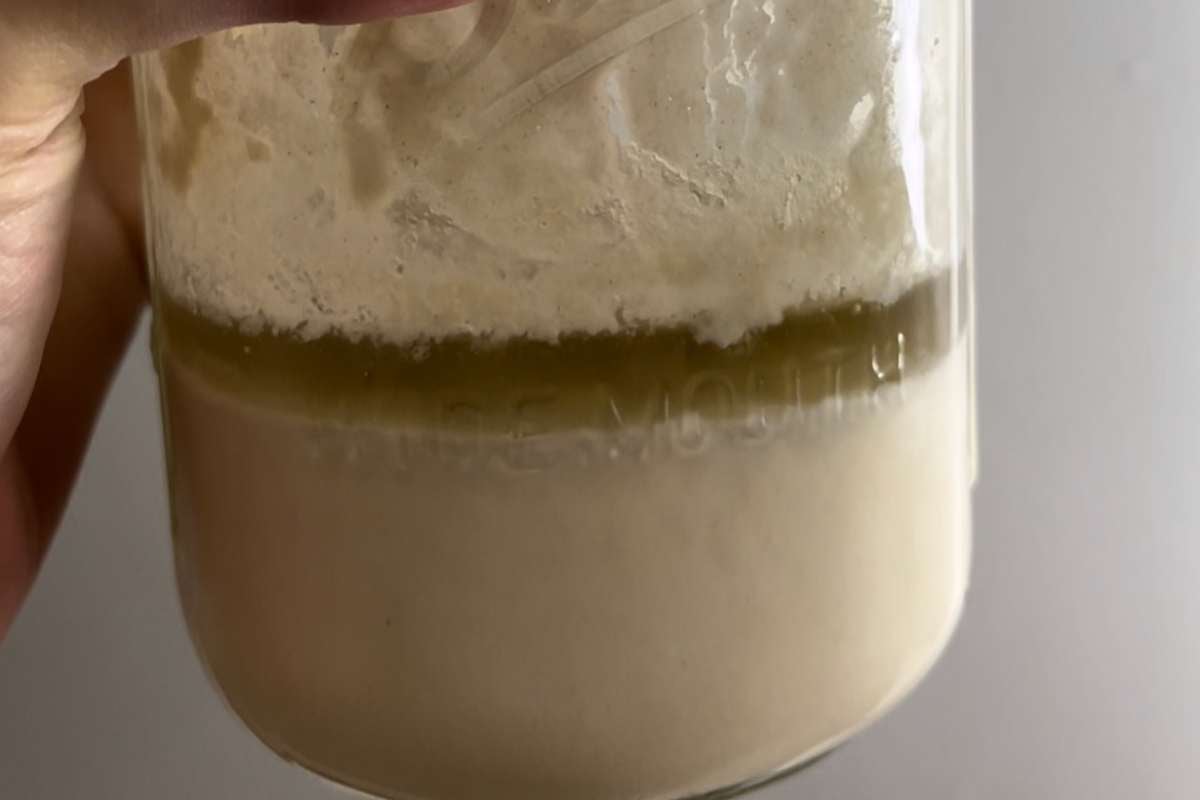
No the only reason your starter is dead is if you see fuzz or pink or orange streaks which are signs of mold. A black liquid is hooch which is a natural byproduct of fermentation and just a sign your starter is hungry.
If your starter smells like acetone or acidic it is most likely hungry. Giving it a feeding or two will fix the problem.
Tips
- Choose a feeding method that works for you—refrigerated, room temperature, or a mix of both.
- Keep your starter well-fed– every 1–2 weeks for fridge storage, daily for counter storage.
- If your starter has been in the fridge for weeks, give it a couple of feedings before baking.
- Be patient with cold starter—since it starts cold it takes longer to rise so use warm water to help.
Feeding a sourdough starter doesn’t have to be complicated. With the right routine, you can maintain a healthy starter without daily upkeep. Whether you store it in the fridge, keep it on the counter, or switch between both, the key is finding what works best for your baking schedule.
Let me know in the comments—how often do you feed your starter? Do you keep it in the fridge or on the counter? I’d love to hear about your experience!




I am new so here is my question: If you do the 1:5:5 ratio. and don’t use all the starter, say I use 100grams. How much water and flour would I feed what’s left?
Hi! Unless you are using it again and need something a specific amount my go to is to discard all but 10 grams and then feed it a 1:5:5 again so 10g start: 50g flour: 50g water.
Emily – I really like your advice and recipes. But I have a question. There’s another ‘sourdough expert’ I read, who also gives a lot of good advice and recipes, and she advises against using RO water. Do you know why that might be? I routinely use RO water and don’t see any problems. I can only figure that maybe RO water doesn’t have as many minerals as tap or spring water. Your thoughts?
Yeah that’s the argument I’ve heard against RO as well because it doesn’t have the minerals. Not really sure if there is much validity to that. I’ve known people that use RO water and it works just fine, like you mentioned as well. If your starter was struggling, I would suggest testing another water source to see if it helps, but in this case, since your starter is good and you don’t have any issues I wouldn’t worry about it.
Hello!
My girlfriend introduced me to you and I’m so encouraged to be able to learn from you. I have begun to mill my own flour exclusively and would like to make sourdough from freshly milled flour. Does you course cover how to do this or do you primarily only use store bought flour.
Thank you for your response. I didn’t want to purchase your class if it doesn’t include directions for freshly milled flour.
Happy Baking
When the blackish “hooch” appears, do I pour that off before feeding, or stir it in? Many thanks!
I prefer to pour it off.
This was so helpful, thank you for all the info. Have a question. Why is my starter runny
Is it runny when you feed it or after it doubles in size? If it is dripping off the spoon after mixing add a little more flour until it is a paste consistency. If it is after it doubles and begins falling back down that is normal to get runny after peak.
Hi, new to sourdough and just put my starter in the fridge for the first time last Tuesday. I have baked with it a few times and my bread is starting to improve. My question is starter maintenance. Since it has been in the fridge for a week, I pull it out, discard. and feed again, I don’t think I will have time to bake again this week so I can toss it back into the fridge? Steps 4 & 5 are a bit confusing. Maintenance in 4 says pop it back in the fridge and 5 talks about it rising. Enjoyed. Your class last week!
Hi Betty thanks I will take a look at my steps to try and improve clarity. If it’s going to be a few weeks in a row of feeding it and not using it I would let your starter sit out for a few hours to rise before placing it back in the fridge. This should help keep it strong. Thanks!
But let it “fall” 1st before back in the fridge? Or place in the fridge at “peak?”
I would place in the fridge at peak.
I could do with some help, I have been following the instructions but nothing much is happening and I’m now about 10 days in, I live in Spain and it’s pretty warm here, the temp on the jar says 30°c, should I be feeding more than once every 24 hours??
Is your starter bubbling at all in between feedings? Are you using whole wheat or rye flour? If not I highly recommend as that will help boost fermentation.
I got a dehydrated rye starter can I just add white flour or should I use rye flour
You can use white flour but it will probably take longer for it to rehydrate. Or you could do a mix of white flour and rye and then slowly wean it off rye once it is established.
Is it true that all the beneficial bacteria is killed when baking, so sourdough is no healthier than regular bread? I’m reading that everywhere.
The health benefit of sourdough comes from the long fermentation process, which breaks down the gluten making it easier to digest.